
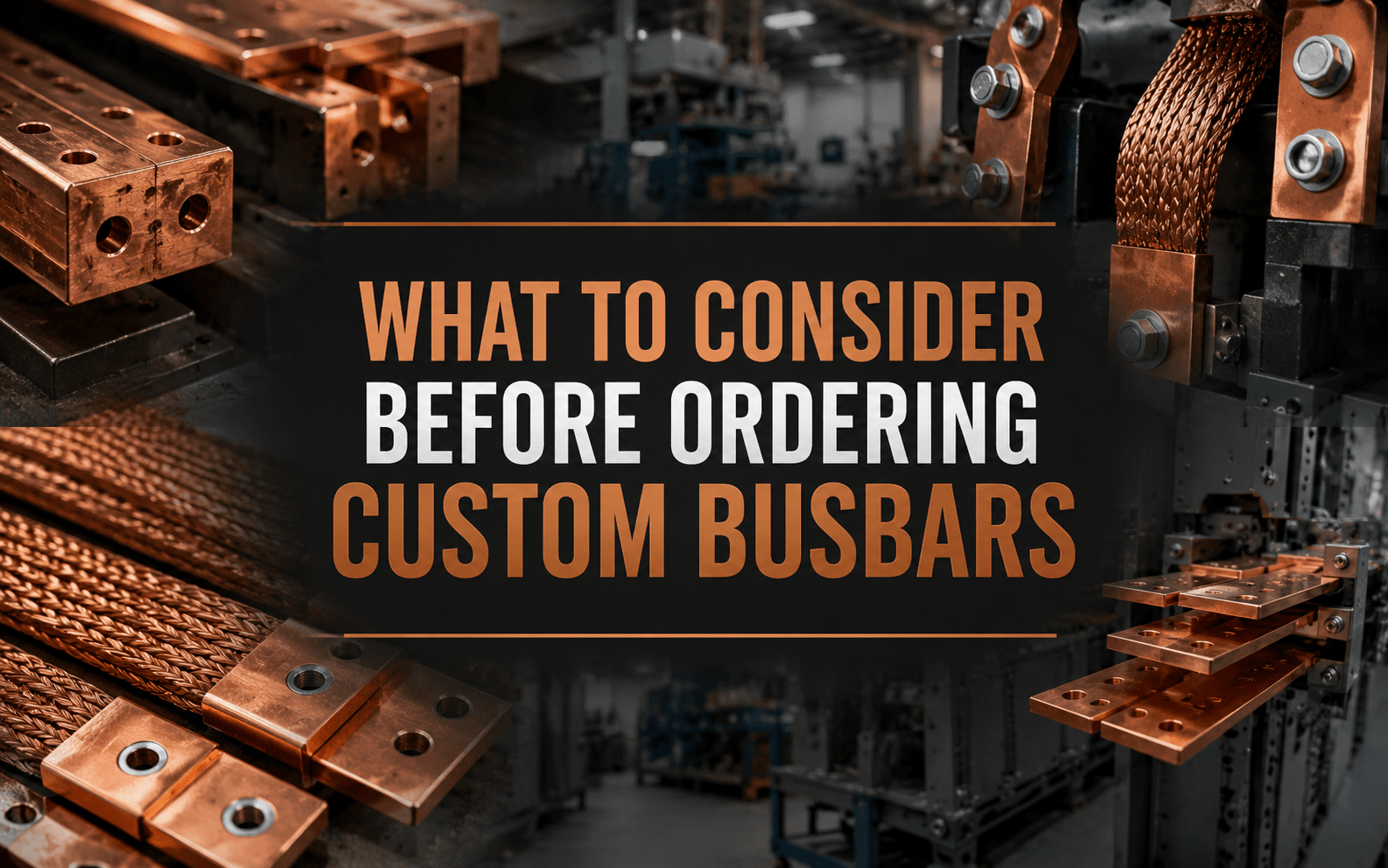
What to Consider Before Ordering Custom Busbars
Custom busbars play an important role in industrial power distribution. They help carry electrical current safely and efficiently between transformers, generators, switchgear, control panels, rectifiers, and other high-current systems.
For procurement managers, operations managers, engineers, and project teams, ordering custom busbars is not only about getting the correct size. A busbar must be manufactured to suit the electrical load, installation space, operating environment, and connection points.
If the wrong details are supplied, it can lead to installation delays, overheating, poor alignment, additional costs, or unnecessary downtime. This is why it is important to confirm the correct information before manufacturing begins.
Mega Flexibles & Busbars manufactures custom busbars and copper connection solutions for industrial applications where reliability, accuracy, and performance matter.
1. Know Where the Busbar Will Be Used
The first step is to understand the application.
A busbar used in a transformer connection may not have the same requirements as one used in a generator system, mining plant, data centre, furnace, rectifier, or industrial distribution board.
Before requesting a quote, confirm:
- What equipment will the busbar connect to
- Whether the system is AC or DC
- The voltage and current requirements
- Whether it will be used indoors or outdoors
- Whether it will be installed inside a panel, enclosure, or an open industrial area
- Whether the system is exposed to vibration, heat, dust, or movement
The more detail you provide, the easier it is to manufacture a busbar that fits the application correctly.
2. Confirm the Electrical Requirements
A custom busbar must be designed to handle the electrical load safely.
The most important detail is the current rating, but other electrical factors also matter. These may include voltage, fault level, phase arrangement, insulation requirements, and whether the system is used for low-voltage, medium-voltage, or DC power distribution.
When requesting custom busbar manufacturing, provide as much of the following as possible:
- Current rating
- Voltage rating
- AC or DC application
- Number of phases
- Fault level, if available
- Earthing or neutral requirements
- Insulation requirements
- Clearance requirements
This helps ensure the busbar is suitable for the system and not only manufactured to a physical size.
3. Choose the Right Material
Copper busbars are widely used in industrial power systems because copper offers excellent conductivity, durability, and performance in high-current applications.
Aluminium may also be used in some electrical systems, but the design must allow for its different conductivity and mechanical properties.
Before ordering, confirm whether the busbar must be manufactured from:
- Copper
- Aluminium
- A specific copper grade
- Bare copper
- Plated copper
- Insulated or sleeved copper
Material selection affects current flow, heat performance, connection design, bending, drilling, and long-term reliability.
For many industrial applications, custom copper busbars remain a strong option because they support efficient power distribution in compact and demanding environments.
4. Supply Accurate Dimensions
Busbars must fit correctly on site. Even a small measurement error can cause problems during installation.
When placing an order, provide accurate details such as:
- Overall length
- Width and thickness
- Bend positions
- Bend angles
- Hole sizes
- Hole spacing
- Slot requirements
- Connection palm size
- Mounting points
- Phase spacing
Where possible, provide a drawing, marked-up sketch, sample busbar, or equipment layout.
Accurate dimensions help reduce delays, rework, and installation issues.
5. Consider Heat and the Operating Environment
Industrial busbars often operate in demanding environments. Heat, dust, humidity, vibration, and limited airflow can all affect performance.
A busbar installed inside a closed enclosure will not behave the same as one installed in open air. A busbar used near furnaces, generators, transformers, or heavy machinery may also need additional design consideration.
Before manufacturing, consider:
- Ambient temperature
- Enclosure ventilation
- Nearby heat sources
- Continuous or intermittent load
- Exposure to dust or moisture
- Corrosive or harsh conditions
This information helps determine whether the busbar requires specific sizing, plating, insulation, or finishing.
6. Check the Connection Points
Many electrical issues begin at the connection point.
A busbar may be correctly manufactured in size, but if the holes, slots, or contact areas do not align with the equipment, installation becomes difficult.
Before ordering, confirm:
- Bolt size
- Number of holes
- Hole spacing
- Terminal size
- Contact surface area
- Whether the holes must be round or slotted
- Whether the busbar connects to copper or aluminium terminals
Good connection design helps support reliable current flow and reduces the risk of poor contact, heat build-up, and mechanical strain.
7. Decide If Flexible Connections Are Needed
Not every connection should be completely rigid.
In industrial power systems, equipment can move, vibrate, expand, or contract during operation. This is common in generator systems, transformer connections, furnaces, mining equipment, and heavy industrial environments.
Where movement or vibration is present, a flexible copper connector may be needed with the busbar. This can help absorb movement and reduce stress on the connection point.
Mega Flexibles & Busbars manufactures both custom busbars and flexible copper connection solutions, allowing clients to source components suited to their full application.
8. Confirm Finishing and Protection Requirements
Depending on the environment, the busbar may require additional finishing.
This may include:
- Bare copper
- Tin plating
- Sleeving
- Insulation
- Heat shrink
- Protective coating
Finishing is important when busbars are exposed to moisture, dust, corrosion, touch safety requirements, or specific project specifications.
It is always better to confirm finishing requirements before manufacturing begins.
Best Practices Before Ordering Custom Busbars
To avoid delays and ensure the correct result, follow these best practices:
- Provide a clear drawing where possible
- Confirm the current and voltage requirements
- Check the installation environment
- Confirm all hole sizes and spacing
- Make sure the latest drawing revision is used
- Include any plating, insulation, or finishing requirements
- Confirm whether flexible copper connectors are also needed
- Share project deadlines or shutdown dates early
- Ask for technical guidance before production starts
The more accurate the information, the smoother the manufacturing and installation process will be.
Conclusion
Ordering custom busbars requires more than a basic measurement. The final product must suit the electrical load, physical layout, operating environment, connection points, and long-term performance requirements.
For industrial teams, a well-specified busbar can help reduce installation problems, improve reliability, and support efficient power distribution.
Mega Flexibles & Busbars manufactures custom busbars, copper flexibles, water-cooled cables, generator bellows, and related electrical components for demanding industrial applications.
Need custom busbars manufactured to your specifications? Contact Mega Flexibles & Busbars to discuss your drawings, requirements, and project needs.
Contact Mega Flexibles & Busbars
For high-conductivity copper solutions, flexible connectors, laminated flexibles, and custom-engineered busbar systems.
🌐 www.megaflexibles.co.za 📧 mark@megaflexibles.co.za 📞 +27 84 434 3621
Supporting mining, power utilities, heavy industry, and infrastructure projects across Southern Africa with reliable copper power solutions built for demanding environments.